Somewhere along the way, Sales Engineers stopped being paid to think and started being paid to perform. Calendars filled up, demos multiplied, PoCs
spawned like mould in a damp basement, and “busy” quietly replaced “effective.” We were told that if we showed the product perfectly, followed the script,
and stayed in our lane, deals would close themselves. They didn’t. What happened was slower pipelines, worse forecasts, and a generation of highly skilled
SEs reduced to polite narrators of someone else’s slide deck. R.I.G.H.T exists to undo that damage and to turn Presales back into a commercial force that
qualifies hard, thinks clearly, and makes money instead of noise.
This video dissects the broken ritual of the “standard”
first sales meeting: scripted demos, zero curiosity, and
everyone talking at the prospect. It shows how presales
became theatre, why it fails, and why real
conversations—not conjuring tricks—are the starting
point of doing sales properly.
Most PoCs fail not because the product is weak, but
because no one defines what success looks like. This
video explains why treating a PoC as a discovery tool
creates drift, ghosting, and wasted time—and why a PoC
only works when purpose, proof, and outcomes are
agreed upfront.
The R.I.G.H.T Framework is not a step-by-step guide to running the perfect PoV, nor is it a rehash of MEDDIC with a new coat of paint. It is a collection of
hard-won ideas, formed over nearly three decades in presales, focused on what actually makes a PoV effective, and what consistently turns presales
engagement into qualified, forecastable revenue.
At its core, R.I.G.H.T exists to change how Sales Engineers think about their role. Not as demo support, not as technical passengers, and not as a
downstream resource pulled into deals too late, but as an active force in qualification. When presales is done well, SEs don’t just validate solutions, they
shape decisions. They surface risk early, bring commercial clarity to technical conversations, and help both Sales and prospects converge on reality faster.
The framework is built around a small number of deliberate principles: always be qualifying, understand that the fundamental purpose of presales is revenue
generation, and improve efficiency through clarity rather than activity. By working closely with Sales, SEs help teams win faster when a deal is real, and fail
faster when it isn’t. In doing so, the SE becomes a guiding light in the deal, bringing structure, insight, and calm to both the sales team and the prospect.
R.I.G.H.T is about turning technical curiosity into outcomes the business will pay for, converting exploration into use cases, use cases into value, and value
into revenue. It’s not about doing more; it’s about doing what matters, earlier, deliberately, and with intent. And when that happens, presales stops behaving
like a cost centre in disguise and starts acting like what it truly is: a force multiplier for revenue.
Presales Should Increase Revenue
Predictability.
Not Just Calendar Activity.
R.I.G.H.T turns Solutions Engineers
into Revenue Qualification Engines.
Most sales organisations run on a conveyor belt model: meeting, demo, PoV, negotiation, hope. The Sales Engineer is constantly busy, but fundamentally
reactive, responding to calendar invites, delivering the “usual demo,” and launching PoVs with loosely defined success criteria and even looser timelines.
There is motion, there is noise, there is activity, but very little clarity. Business pain is assumed rather than validated. Impact is discussed but rarely
quantified. Executive alignment is hoped for, not engineered. Qualification becomes superficial, and the PoV quietly turns into the strategy. “If we run it well
enough, they’ll buy.” That isn’t strategy. It’s hope disguised as process, and hope is not a revenue model.










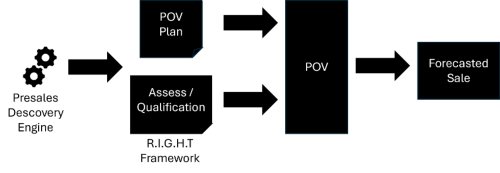
R.I.G.H.T Framework
R.I.G.H.T Framework




The Current Problem
Initial Meeting
&
Demo
POC

Hope