Real world example:
I once worked on an opportunity that, on paper, looked like a guaranteed win. The customer was a large enterprise with a problem that
was costing them tens of millions of dollars. The solution I was selling could be implemented in a matter of months and would have cost
just over $150,000. The ROI was obscene, it would have paid for itself in weeks. I built the spreadsheets, analysed the logs, validated the
assumptions, and produced a business case so solid it should have embarrassed anyone who ignored it.
They never bought it.
The reason was simple and brutal: no one owned the problem. The cost was real, but it was distributed across multiple regional business
units. It showed up everywhere and belonged to no one. There was waste, but there was no pain. More importantly, there was no one
with authority who felt exposed by it. The organisation had quietly accepted the loss as the cost of doing business.
When I asked the harder questions, the deal collapsed under its own honesty. What improves if they fix it? Very little. Marginal
efficiency gains, fewer edge-case losses, nothing that changed anyone’s job, reputation, or outcome. What breaks if they do nothing?
Nothing at all. Doing nothing was not a risk; it was a perfectly safe option.
The internal team were furious. Headcount was frozen, travel was restricted, system upgrades were delayed, yet here sat a problem that
could have freed up millions for a trivial investment, and no one cared. Not because the maths was wrong, but because the impact was
irrelevant. Nothing was fundamentally broken. Nothing meaningfully improved. And no one who mattered felt the pain.
That was the moment I learned a lesson every presales engineer eventually learns the hard way: great ROI doesn’t close deals,
ownership, impact, and consequence do.
Despite investing several days building what were, in hindsight, award-winning spreadsheets for a deal that was already dead, I did have
one saving grace: they kept asking for a PoV, and I kept refusing it. The account manager was furious. From his perspective, a PoV
meant progress, activity, momentum. From mine, it meant months of work with no commercial outcome. I couldn’t see how a PoV
would improve anything, because nothing about the situation had changed: no owner, no urgency, no consequence of inaction. I stuck to
my position, and I’m glad I did. That PoV would have dragged on for months, filled my calendar, and produced exactly one result, proof
that the internal teams were right to be frustrated. Without a PoV explicitly anchored to a purchase decision, it wouldn’t have been
validation; it would have been a science project. Interesting, busy, and ultimately useless.
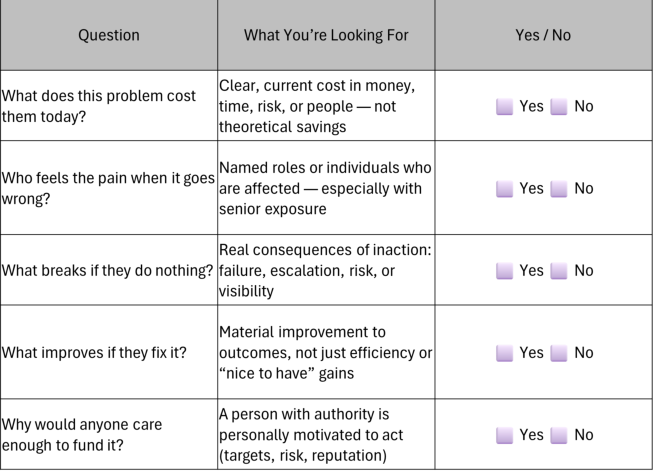
What does this problem cost them today? (money, time, risk, people)
Every real problem already has a price tag, most teams just pretend they don’t know it yet. It costs money in wasted effort, duplicated
work, rework, fines, missed revenue, or inefficiency that quietly compounds every month. It costs time in delays, manual work,
firefighting, meetings about meetings, and people doing jobs software should already be doing.
It creates risk operational risk, compliance risk, reputational risk, the kind that doesn’t show up on a dashboard until it explodes into an
incident report or a board-level apology. And it costs people: burnout, attrition, frustration, and the slow erosion of trust between teams
who blame each other for problems no one owns. If a prospect can’t describe what this problem is costing them today, then either the
problem isn’t real yet, or you’re not talking to the right person.
Who feels the pain when it goes wrong?
When something goes wrong, the pain is never evenly distributed, it always lands on specific people. The frontline teams feel it first,
drowning in manual work, firefighting, and blame. Middle management feels it next, stuck explaining missed targets, broken processes,
and “unexpected issues” to people above them. Eventually, if the problem festers, the pain reaches executives in the only language they
truly understand risk, revenue, reputation, and board scrutiny.
This matters because problems don’t get funded by those who suffer quietly, they get funded when someone senior feels exposed. Your
job in presales is to trace the pain upstream, from the people doing the work to the people signing the cheque and make that connection
explicit. Until the pain has an owner with authority, it isn’t a problem, it’s background noise.
What breaks if they do nothing?
Doing nothing is never neutral; it just delays the damage. If the problem is ignored, workarounds harden into process, spreadsheets
become “systems,” and tribal knowledge replaces design. Small failures become frequent, frequent failures become accepted, and
accepted failures become invisible, right up until they aren’t. Costs creep, risk accumulates, people burn out, and accountability
evaporates.
The organisation doesn’t collapse overnight; it slowly degrades, one missed SLA, one manual fix, one quiet resignation at a time.
Eventually something public breaks, a customer, an audit, a revenue line, and what could have been a controlled decision turns into a
forced reaction. When a prospect believes that doing nothing is safe, your real job is to show them that inertia is the most expensive
option on the table.
What improves if they fix it?
When the problem is fixed, improvement shows up as clarity, control, and momentum, not just better technology. Work that was manual
becomes predictable, exceptions shrink, and teams stop firefighting and start executing. Time is returned to the business, not as a
theoretical saving, but as fewer escalations, cleaner handoffs, and decisions made with confidence instead of guesswork. Risk moves
from reactive to managed, visibility replaces hope, and accountability becomes possible because the system reflects reality. People stop
compensating for broken process and start doing the jobs they were hired to do. And at the executive level, improvement is felt as fewer
surprises, stronger forecasting, and the quiet confidence that comes from knowing the business is no longer held together by heroics and
spreadsheets. That’s the outcome you sell, not the feature list.
Why would anyone inside that company care enough to fund it?
Problems don’t get funded because they’re real; they get funded because someone powerful is exposed. Inside every organisation,
money only moves when the cost of action becomes lower than the cost of embarrassment, risk, or missed ambition. Individuals care
enough to fund a problem when it threatens their targets, their credibility, their bonus, or their standing with peers and superiors. Middle
managers fund to stop the bleeding; executives fund to remove uncertainty and protect outcomes. Your job in presales is to identify
whose name ends up on the slide when things go wrong, and whose name goes on the success story if they go right. Until the problem is
personally meaningful to someone with authority, it will remain acknowledged, discussed, and endlessly deferred, but never paid for.
How to Read the Scorecard
5 Yes → Proceed. Real problem, real deal.
3–4 Yes → Re-qualify. Something important is missing.
0–2 Yes → Stop. This is a science project waiting to happen.
CONSEQUENCE
What happens if nothing changes?
OWNER
Who is accountable when this goes wrong?
OUTCOME
What materially improves if this is fixed?





COST
What is this costing the business right
now?

IMPACT

T

H

G

R

I
Impact is the difference between being busy and being paid. Pain tells you something is wrong; impact explains why
anyone should care. If a problem doesn’t cost money, create risk, waste time, threaten revenue, or make someone senior
look bad, it isn’t a deal, it’s a conversation. Demos without impact are theatre. PoVs without impact are science projects.
Pipelines without impact are lies we tell ourselves to feel productive. Your job in presales is not to show features or prove
the product works; it’s to expose what breaks if nothing changes and what improves if it does. When you can clearly
articulate the commercial consequence of inaction, deals accelerate, stakeholders appear, and budgets materialise. When
you can’t, you’re just another well-meaning technician keeping busy while the real money goes elsewhere.