R

I

G
Half of Presales is technical execution. The other half is qualification and forecast discipline. Accurately calculating ,
not guessing , whether a deal can validate, clear procurement, survive legal, provision, integrate, and deliver impact
within a realistic window is not optional. It’s the job. A professional SE doesn’t just prove the product works; they
prove the timeline works. Because a PoV without a credible Time Scale isn’t progress, it’s liability. The company
doesn’t need more demos. It needs deals that close when forecasted. And that starts with you having the backbone to
align ambition with reality before anyone commits the number upstream.
It's tempting to think that Time Scales exist purely for internal forecasting, something the CRO needs, something
Finance and the board care about. And that's true, as far as it goes. But the prospect needs them just as much. Without
credible Time Scales, your champion is selling fog internally: no dates, no milestones, no clarity, just enthusiasm and
a demo replay. Time Scales don't just stabilise your forecast, they create a believable future for the customer, and that
believable future is what actually gets deals funded.
The most basic Time Scale is the proof-of-value engagement itself, and it should never be vague. A defined start and
end date, clear success criteria, agreed tasks with named owners, check-in milestones, and a final evaluation session,
without this structure, a PoV becomes an experiment. With it, it becomes a decision engine. Crucially, under a
disciplined qualification framework the agreement should already exist before the PoV begins: if it succeeds against
the agreed criteria, the deal moves forward. Which means the PoV timeline is not the end of the story. It is the
beginning of a commercial sequence, and you and the AE should immediately map the post-validation path the
moment the PoV schedule is agreed, not emotionally, but logically.
Time is the fourth dimension of a deal, and a well-constructed timeline is one of the most powerful tools available to
test whether a deal is real. When a prospect says they need this implemented by August, that statement is either a
commitment or a wish, and the timeline will tell you which. Work backwards from August and the picture becomes
clear very quickly: account for procurement, legal review, security approval, vendor onboarding, and internal
purchase order processing, and suddenly August either holds or it doesn't. If the customer engages seriously with that
reverse-engineered schedule, adjusts their own plans to make the dates work, and pulls in the right internal
stakeholders to confirm it, you have genuine intent. If they shrug, go quiet, or push back on the process rather than
the specifics, you have a signal worth paying attention to. A well-developed timeline doesn't just plan the deal, it
pressure-tests it. And the earlier you surface that tension, the better for everyone. Once the realistic PO landing date is
known, the next phase becomes visible, handover from presales to post-sales, implementation kickoff, environment
provisioning, integration work, data migration, change control windows, training, and go-live. Laying this out does
two powerful things simultaneously: it gives the prospect a credible image of their own future, and it gives the
champion a roadmap they can use to brief IT, prepare Operations, secure executive backing, and start talking about
ROI. The conversation shifts from "let's test the product" to "this is how transformation unfolds", and that is a
completely different conversation to be having.
Time Scales should also extend well beyond deployment into the 90-day, six-month, and twelve-month horizon. Is
there a Phase 2? An expansion? Additional modules, more users, a geographic rollout? The label doesn't matter, what
matters is that you have shown the prospect this isn't a one-off purchase but a structured programme aligned to their
broader ambitions. That framing makes budget conversations considerably easier, because the investment has a story
arc rather than just a price tag. But the most important discipline around Time Scales isn't drawing them, it's stress-
testing them. Are they achievable? Are the right people available? Are there holidays, change freezes, budget gates,
or competing initiatives that could derail the sequence? Has procurement actually confirmed their timelines, or are
they assumed? Has legal been warned? Time Scales that haven't been pressure-tested aren't plans. They're fantasy.
And fantasy pipelines collapse.
Done properly, Time Scales benefit everyone involved. For the vendor they improve forecast accuracy, reduce
slippage, and create predictability. For the prospect they remove ambiguity, align departments, clarify the timing of
ROI, and give executives the confidence to commit. For the champion specifically, they provide structure, narrative,
and a sense of control, and that is real political power inside an organisation. Time Scales are not about applying
pressure; they are about professionalism, and, used well, they are a deal-driving mechanism in their own right. They
connect proof-of-value to procurement, procurement to purchase order, purchase order to deployment, deployment to
measurable impact, and impact to expansion. When everyone agrees on them, understands them, and believes they
are achievable, you have momentum. When they are vague, assumed, or left unspoken, you have a calendar full of
meetings, and nobody needs more meetings.
TIME SCALES
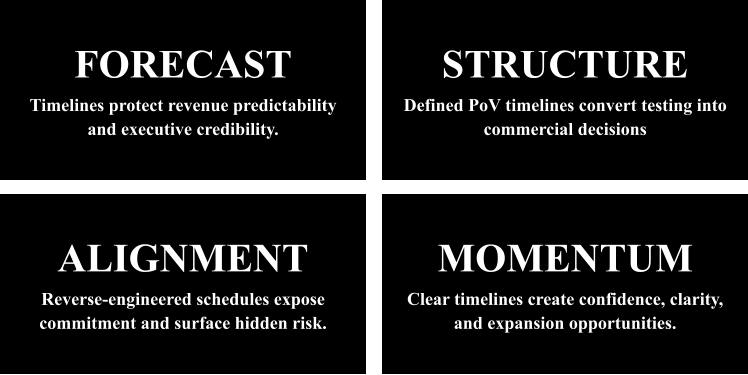
Four Pillars of Time Scales
Time Scales are not an administrative afterthought at the end of a PoV. They are part of the sales forecast. And the
forecast is the lifeblood of the company. When the CRO commits a number to the board, and the board signals
confidence to investors, they are relying on timelines embedded inside deals , including yours. If your PoV is “probably
Q2… maybe Q3… depends how it goes,” that isn’t harmless optimism. That’s volatility in the forecast. And volatility
destroys credibility. Like it or not, you are in sales. Technical ability gets you through a PoV; credible, defensible Time
Scales are what make the revenue predictable. And predictability is what markets reward.

H

T