
R
I
HYPOTHESIS
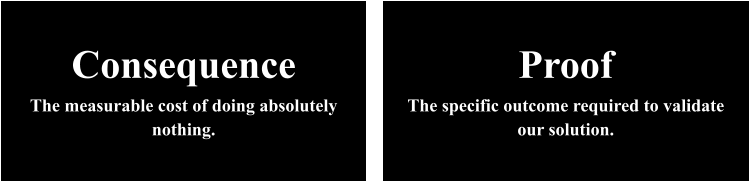
Consequence The measurable cost of doing absolutely nothing. Proof The specific outcome required to validate our solution.
Path The clear route from validation to signed purchase order.
Five Pillars of Hypothesis
Hypothesis is the moment Presales stops being reactive and starts behaving like a commercial strategist. It is a written theory of how the deal closes, who moves, why they move, what must be proven, and when it happens. If you cannot articulate your win theory in under 60 seconds, you are not qualifying. You are hoping.
.

T

G

H

© 2026 Will Matthews. The R.I.G.H.T Framework™ — Built from 27 years in enterprise presales and technical sales. Cambridgeshire, United Kingdom. Contact: wmatthews@elmsectest.co.uk
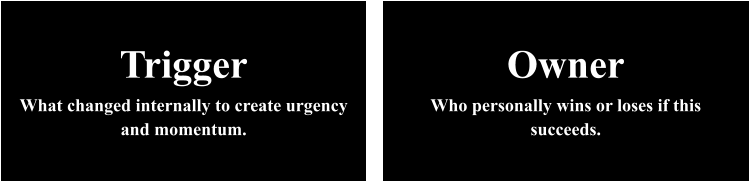
Hypothesis is where presales stops being busy and starts being commercial. Reason tells you why they're talking. Impact tells you what it's worth. Timescales apply pressure. Guardrails define the boundaries. But Hypothesis is different, it's the moment you step back and say, based on what we know, this is how this deal closes. It is a written, testable theory of the win, and it is what separates genuine pipeline from organised hope. Every strong Hypothesis stands on five pillars. The first is the Trigger, what changed internally to create urgency and momentum, because if nothing has shifted, the status quo will win every time. The second is the Owner, who personally wins or loses if this succeeds, because organisations don't buy, individuals push decisions through. The third is Consequence, what is the measurable cost of doing nothing, because no consequence means no urgency, and no urgency means no deal. The fourth is Proof, what specific outcome must be demonstrated, not features, not theatre, but clear business validation that something real has been achieved. The fifth is Path, the route from validation to purchase order, because if you cannot map that path, you cannot forecast the revenue. Hypothesis forces clarity. It removes hope from the pipeline and replaces it with logic. If you cannot articulate your win theory in sixty seconds, you do not have a deal, you have activity. And activity doesn't close business
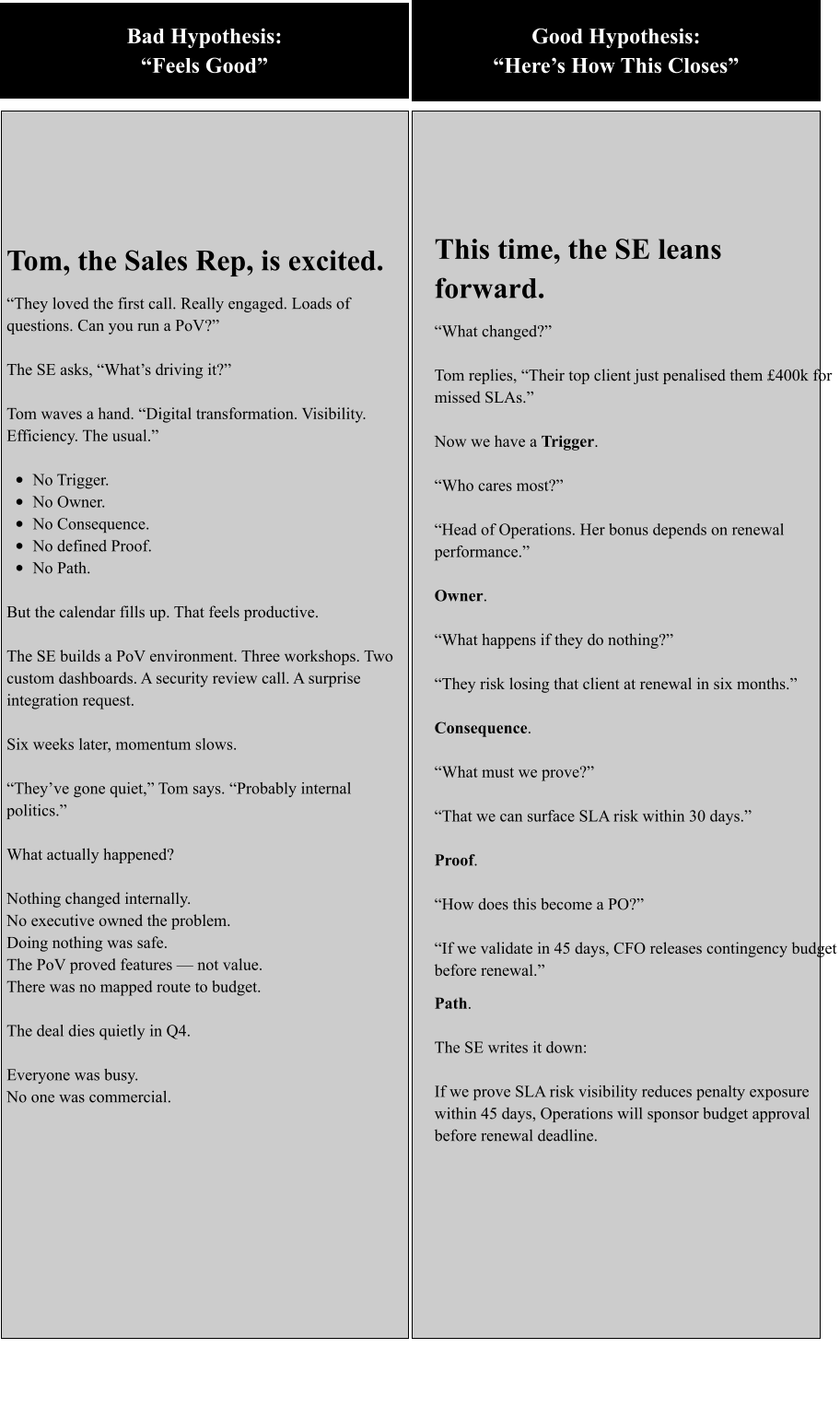
Tom, the Sales Rep, is excited.  “They loved the first call. Really engaged. Loads of questions. Can you run a PoV?”  The SE asks, “What’s driving it?”  Tom waves a hand. “Digital transformation. Visibility. Efficiency. The usual.”  •	No Trigger. •	No Owner. •	No Consequence. •	No defined Proof. •	No Path.  But the calendar fills up. That feels productive.  The SE builds a PoV environment. Three workshops. Two custom dashboards. A security review call. A surprise integration request.  Six weeks later, momentum slows.  “They’ve gone quiet,” Tom says. “Probably internal politics.”  What actually happened?  Nothing changed internally. No executive owned the problem. Doing nothing was safe. The PoV proved features — not value. There was no mapped route to budget.  The deal dies quietly in Q4.  Everyone was busy. No one was commercial. Good Hypothesis:  “Here’s How This Closes” Bad Hypothesis:  “Feels Good” This time, the SE leans forward.  “What changed?”  Tom replies, “Their top client just penalised them £400k for missed SLAs.”  Now we have a Trigger.  “Who cares most?”  “Head of Operations. Her bonus depends on renewal performance.”  Owner.  “What happens if they do nothing?”  “They risk losing that client at renewal in six months.”  Consequence.  “What must we prove?”  “That we can surface SLA risk within 30 days.”  Proof.  “How does this become a PO?”  “If we validate in 45 days, CFO releases contingency budget before renewal.”  Path.  The SE writes it down:  If we prove SLA risk visibility reduces penalty exposure within 45 days, Operations will sponsor budget approval before renewal deadline. Owner Who personally wins or loses if this succeeds. Trigger What changed internally to create urgency and momentum.